

How to Organise Spices: Sorting, Labelling and Storage Systems for a Real-World Kitchen
A tidy spice collection saves time, money and a surprising amount of stress when you’re cooking. In 2025, there are more ways than ever to store and refill spices, but the basics still matter: sort them logically, label them clearly, and protect them from heat, light and moisture. Below is a practical, kitchen-tested approach that works whether you cook daily or just want to stop buying duplicate jars.
Sorting spices: build a system that matches how you cook
The best sorting method is the one you’ll keep using when you’re tired, in a rush, or cooking with one hand while stirring with the other. Start by pulling every spice out in one go, including refill pouches and blends hiding at the back. Check what you actually use, what you rarely touch, and what’s expired. If a jar has no smell or has clumped into a solid mass, it’s probably past its best.
A reliable approach is to sort by frequency first: daily staples (salt, pepper, garlic granules, paprika), regulars (cumin, turmeric, oregano), and occasional or niche items (asafoetida, sumac, fenugreek). This makes storage decisions easier later because your “front row” becomes obvious. If you prefer cooking by cuisine, a second layer of sorting works well: Italian herbs together, curry spices together, baking spices together, barbecue rubs together.
Don’t forget to separate whole spices from ground ones. Whole spices (peppercorns, cumin seeds, coriander seeds, cinnamon sticks) usually keep their flavour far longer than ground equivalents, and they’re often used differently. Keeping them together also helps you spot when you could switch to whole and grind small amounts for better aroma and less waste.
How to decide what stays and what goes
Spices don’t “go bad” in the same way fresh food does, but they do fade. A simple 2025 rule of thumb: if you can’t smell it clearly when you open the lid, it won’t taste of much in your food. Ground spices often lose punch faster than people expect, especially if they’ve been stored above the hob or near a kettle where steam is common.
Use a quick audit method: open, smell, pinch a tiny bit between your fingers and smell again. If the scent is weak or dusty, move it to a “use up soon” group (good for soups, stews, marinades) and replace only what you genuinely use. This prevents the common kitchen problem of having 40 jars but only 10 that actually deliver flavour.
If you buy in bulk, keep bulk stock separate from daily-use jars. Bulk bags should be sealed tightly and stored away from light. Your daily jars should be smaller, easy to grab, and easy to refill. This stops you tipping a huge bag over your counter every time you need a teaspoon of something.
Labelling spices: clear names, dates and consistency
Labelling sounds simple until you’re staring at three similar-looking brown powders in identical jars. In practice, labels reduce mistakes (smoked vs sweet paprika), prevent duplicates, and help you track freshness. In 2025, many people use refill systems and matching containers, so a consistent label style matters more than ever.
At minimum, each label should include the spice name in plain English and, if relevant, a key detail such as “ground”, “whole”, “smoked”, or “hot”. If you store in drawers, top labels are essential because you’ll be reading from above. If you store on shelves, front labels matter most. Many households now combine both: a small front label plus a top label for speed.
Dates are often skipped, but they’re the difference between a collection that stays useful and one that slowly turns into a museum. You don’t need to be obsessive. Adding a “packed” or “opened” month and year is enough. If you refill from bulk, write the refill date. This makes it obvious when something has been sitting untouched for too long.
Best label formats for busy kitchens
For handwriting, a water-resistant marker on matte labels is still one of the most practical options. It doesn’t smear, it survives wiping, and you can update it without needing fancy equipment. If you prefer printed labels, keep the design simple and high-contrast so you can read it quickly in low light.
Use short, standardised names. For example: “Coriander (ground)” and “Coriander (seed)” rather than long descriptions. This keeps labels neat and prevents confusion. If you cook with multiple naming traditions (for instance, coriander vs cilantro), you can add a second name in smaller text. The point is to avoid the moment where you hesitate mid-recipe because the jar isn’t obvious.
Colour-coding can help, but only if it stays consistent. One sensible method is to colour-code categories: baking, chilli/hot spices, herbs, blends. But don’t overcomplicate it. A label system should save time, not become a craft project you abandon after one weekend.
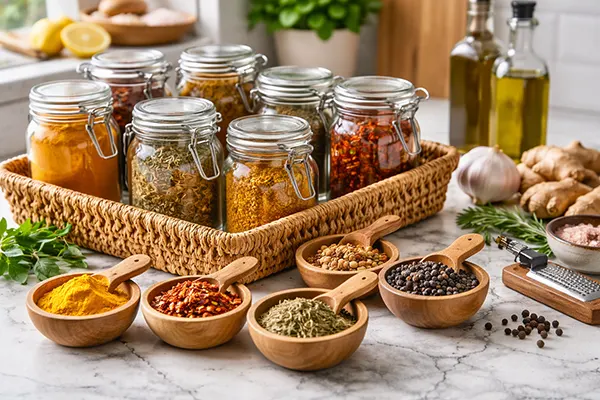
Storage solutions: cupboards, drawers and freshness protection
Spice storage is mainly about protecting flavour. Heat, direct light, and moisture are the main problems—so storing spices above the cooker is usually the worst option, even if it looks convenient. In 2025 kitchens, drawers have become a favourite because they keep spices dark and easy to scan, but cupboards can work just as well with the right setup.
If you use a cupboard, add a tiered rack or riser so you can see everything without moving jars. For deep cupboards, pull-out shelves or baskets reduce the “lost at the back” issue. If you use a drawer, lay jars flat with labels facing up, and keep the most-used spices in the front zone. The goal is to see every jar at a glance.
Container choice matters more than people think. Airtight jars protect against humidity and keep aromas inside rather than perfuming your entire cupboard. If you store spices in their original jars, make sure lids close properly and that jars aren’t stored where steam hits them. If you decant into matching jars, choose ones with tight seals and openings that fit measuring spoons easily.
Keeping spices fresh in 2025: practical habits that work
Keep spices away from heat sources as a default rule. A spice drawer or a cupboard on the opposite side of the kitchen from the hob often works best. If your kitchen is small and you can’t avoid heat entirely, prioritise moving your most delicate items (ground herbs, chilli flakes, paprika) to the coolest, darkest spot.
Manage moisture proactively. Never shake spices directly over steaming pans unless the jar is designed to prevent steam entering. A simple habit is to pour or spoon into your hand or a small dish first. Clumping is often a sign of moisture exposure, and once it starts, flavour loss accelerates.
Create a “maintenance routine” that fits real life. Every 2–3 months, do a quick check: wipe jars, confirm labels are still readable, and move anything old to the front so it gets used. Once a year, do a full refresh: dispose of dead spices, restock only what you use, and adjust your categories if your cooking habits have changed.