
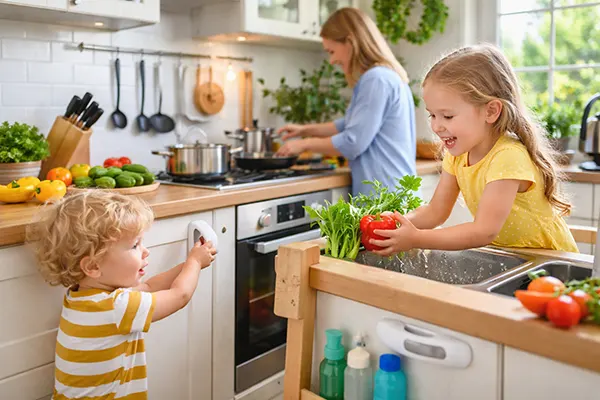
Kitchen safety for children: what to remove, what to lock, what to teach (by age)
Most kitchen accidents with children happen in seconds: a mug of tea pulled down, a pan handle grabbed, a dishwasher door climbed on, or a single small battery swallowed. The aim is not to turn the kitchen into a no-go zone, but to make the risky things physically hard to reach, and the safer behaviours easy to repeat every day. This guide breaks it down by age, because what works for a crawling baby is different from what works for a curious four-year-old or a confident ten-year-old.
Babies and early crawlers (0–12 months): remove reachables and control the floor zone
At this age, the kitchen risk is mainly “down low”: anything that can be grabbed, mouthed, or toppled. Start with the lowest cupboards and drawers: move all cleaning products, dishwasher tablets, sharp tools, alcohol, matches/lighters, and spare button batteries into one high cupboard that can be locked. If you cannot go high, go locked and consistent—one “danger cupboard” is easier to keep secure than several half-safe spots.
Next, build a predictable floor routine. Babies explore with their hands and mouth, so treat the kitchen floor like a ‘no small parts’ area. Sweep quickly after cooking, keep pet bowls away from the main walkway, and be strict about dropped items such as cherry tomatoes, grapes, nuts, popcorn, and anything with wrappers. Check under the kickboards and around the fridge where small items collect without you noticing.
Heat is still a problem even before a child can walk, because adults carry hot liquids and babies are often held. Make it a rule that you do not drink hot tea or coffee while holding a baby, and you never place a hot drink on a low table edge. Keep kettle leads and appliance cables pushed to the back of the worktop, so nothing dangles. If you use a slow cooker, air fryer, or rice cooker, treat the cable like a hazard: short, tight, and out of reach.
What to teach early (0–12 months): simple boundaries and your “one-hand rule”
You cannot “teach” kitchen rules in the usual sense yet, but you can teach patterns. Pick one consistent boundary (for example, a play mat line, a high chair position, or a gated doorway) and always place your baby behind it before you do anything involving heat, knives, glass, or chemicals. The habit you are building is yours: pause, park baby safely, then cook.
Use the same short phrases every time: “Hot. Back.” “Sharp. No touch.” “Wait.” Babies understand tone and repetition long before they understand explanations. When they reach, gently block and redirect without turning it into a game. Consistency matters more than volume.
Practise your “one-hand rule”: if you are carrying your baby, your other hand is free but your attention is divided. Make it a default that you do not pour boiling water, drain pasta, carry pans, or open an oven while holding a baby. This is one of the easiest ways to reduce scald risk in real life, because it cuts out the most common rushed moment.
Toddlers and preschoolers (1–4 years): block access and assume they can climb
Between one and four, children go from wobbling to climbing, and they can reach higher than most adults expect. Physical barriers are your best friend: fit child locks to lower cupboards/drawers that store cleaning products, sharp tools, medicines, and alcohol, and use an oven door lock if your model runs hot on the outside. Consider a hob guard if you have front controls or a child who likes to reach up; if you have induction, still remember residual heat and hot pans can burn even after the ring is “off”.
Rearrange the worktop with intent. Keep kettles, hot drinks, and heavy appliances away from the edge, and turn pan handles inwards every time, not only when a child is watching. Avoid tablecloths and long placemats that can be tugged. If you use a high chair, position it where a toddler cannot grab the hob, kettle, or knife block while you turn your back for a second.
Small items become serious at this age: button batteries, fridge magnets, and tiny parts from kitchen timers, remote controls, singing toys, and novelty lights. Store spare batteries in a locked place and check products that have battery compartments to make sure they are secured properly. This is not “rare”; it is common enough that UK product-safety campaigns keep repeating the message, because the harm can be severe and fast.
What to teach (1–4 years): three core rules that match how toddlers learn
Keep it to three rules and repeat them daily: “Stop at the line,” “Ask before you touch,” and “Hands off when it’s hot.” Use a real visual cue such as tape on the floor, a small rug, or a safe stool spot. Toddlers do better with “where to stand” than with abstract warnings.
Teach safe participation instead of constant “no”. Give them one approved task: washing vegetables in a bowl, stirring cold ingredients, placing napkins, or carrying unbreakable items to the table. The point is supervision with structure: they feel included, but the hazards stay controlled. If you only ban them, they look for unsupervised moments to copy you.
Add a calm emergency script. If something is hot: “Hands up, step back, tell an adult.” If a spill happens: “Freeze, don’t run.” For burns and scalds, adults should know to cool the burn with cool or lukewarm running water for 20 minutes as soon as possible, and children should learn that the first step is telling you immediately, not hiding it because they fear trouble.
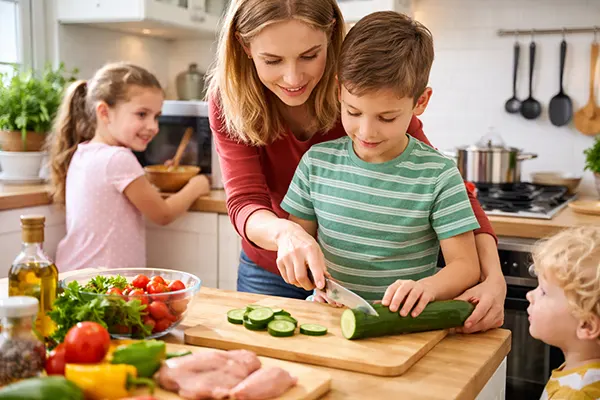
School-age children (5–12 years): step-by-step independence with clear limits
From five onwards, the goal shifts: you still block the big hazards, but you also train skills. Start with “permission levels” rather than vague trust. Example: Level 1—make cold snacks only; Level 2—use the toaster with an adult in the room; Level 3—heat food in the microwave; Level 4—use the hob for one pan with supervision. Write these levels down and keep them the same across carers, otherwise children test the weakest rule set.
Update the environment for real cooking practice. Use the back rings first, keep pan handles turned in, and store sharp knives in a locked drawer or high place until you are ready to teach knife skills properly. Keep a stable step stool for handwashing and supervised prep—children climbing on chairs is a fall risk waiting to happen, especially near hot surfaces and hard floor edges.
Teach safe food handling along with heat safety. School-age children can understand why raw chicken juice on a chopping board is not “just a bit messy”, and why reheating rice needs care. Show them the simple basics: wash hands with soap, use separate boards for raw meat, clean surfaces, and keep cold foods cold. These habits protect them now and make teen independence far safer later.
What to teach (5–12 years): practical cooking safety, not lectures
Knife skills should be taught, not assumed. Start with a small, sharp kitchen knife that fits their hand (dull knives slip), a stable board, and the “claw grip” for fingers. Teach them to carry a knife pointed down, never to leave it hidden in a sink, and to put it down flat on the counter when interrupted. A simple rule helps: if you are not cutting, the knife is parked.
Heat safety needs routines, too. Teach them to check a pan handle before moving it, to lift lids away from their face (steam burns), and to keep sleeves and tea towels away from the hob. If they microwave food, teach stirring and standing time, because hot spots can burn. Make them announce what they are doing—“I’m using the hob now”—so you can listen for risky moments without hovering.
Finally, teach what to do when things go wrong. For minor burns, the adult standard is running cool water for 20 minutes, then cover appropriately; for bigger burns, burns on the face, or if you’re unsure, seek medical advice promptly. Children do not need the full decision tree, but they do need one non-negotiable instruction: tell an adult immediately, even if they think they will get in trouble. Safety beats blame every time.