
How to Store Bread, Bakes and Homemade Desserts So They Stay Fresh for Longer
Freshly baked bread, warm pastries and homemade desserts are usually at their best soon after they leave the oven, but the way they are stored afterwards can make a considerable difference to their texture, flavour and usable life. A loaf left open on the worktop quickly becomes dry, while bread sealed when it is still warm may develop condensation and encourage mould. Cakes can suffer in much the same way, and desserts containing cream, custard or soft cheese have the added requirement of safe refrigeration. Good storage therefore starts with recognising what kind of food you have rather than putting every bake into the same container. Room temperature suits many dry baked goods, the fridge is essential for perishable fillings and toppings, and the freezer is often the best choice when something will not be eaten soon. A few simple habits can preserve quality, reduce unnecessary food waste and make homemade baking easier to manage throughout the week.
How to Store Bread Without Losing Its Texture or Flavour
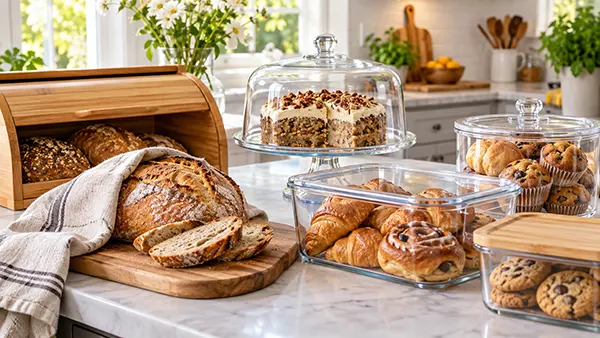
For most ordinary loaves, a cool and dry cupboard or a clean bread bin is a better everyday storage place than the refrigerator. Refrigeration may slow mould growth, but bread generally becomes stale more quickly at fridge temperatures, so putting every loaf straight into the fridge can solve one problem while creating another. A bread bin is particularly useful because it protects the loaf from direct sunlight, heat and excessive airflow without exposing it to the cold environment of the fridge. Keep it away from the cooker, kettle, dishwasher and other places that regularly become warm or humid. Bread should also be completely cool before being packed away. A loaf that still feels warm releases moisture, and trapping that moisture inside a sealed bag creates the damp conditions in which mould develops more readily.
The most suitable wrapping depends partly on the bread itself. Soft sliced sandwich bread normally keeps its texture better when its original bag is folded or sealed properly after each use, because limiting airflow slows moisture loss. Homemade sandwich loaves can be placed in a clean food bag or well-fitting bread container once completely cool. Crusty sourdough, baguettes and similar loaves need slightly different treatment because completely airtight wrapping can soften the crust. If they are going to be eaten within a day, paper or a bread bag can offer a reasonable balance between preventing excessive drying and preserving the crust. After cutting a crusty loaf, placing the cut side down on a clean board for a short period can also reduce moisture loss from the exposed crumb. For longer storage, however, freezing is more reliable than trying to preserve a loaf at room temperature for several extra days.
Check the storage area as well as the bread itself. Crumbs left in a bread bin and traces of old food in reusable bags can provide favourable conditions for mould, so containers should be emptied and cleaned regularly and allowed to dry before fresh bread is added. If visible mould develops on bread, the safest choice is to discard it rather than remove the affected section and eat the rest. Mould can spread beyond the patch that is easy to see, particularly through soft and porous foods. Stale bread without mould is a different matter. It can still be useful for toast, croutons, breadcrumbs, bread-and-butter pudding or stuffing. This distinction is worth remembering: dryness is usually a quality problem, whereas visible mould is a reason not to use the loaf.
Freezing Bread When You Will Not Finish the Loaf Quickly
Freezing is one of the easiest ways to prevent a good loaf from becoming stale or mouldy before it can be eaten. If you already know that only part of a loaf will be needed during the next day or two, freeze the remainder while it is still fresh instead of waiting until its texture has started to deteriorate. Sliced bread is especially convenient because individual pieces can be removed as required. Homemade loaves can be sliced before freezing for the same reason. Pack the bread in a freezer-safe bag or wrap it securely so that as little air as practical reaches the surface, pressing excess air from the bag before closing it. If slices tend to stick together, freezing them in smaller portions or separating portions before packing makes it easier to take out exactly what is needed.
A domestic freezer operating at around -18°C keeps frozen food at an appropriate storage temperature, although the quality of bread can gradually decline during long storage. Labelling the bag with the type of bread and freezing date prevents forgotten loaves from accumulating at the back of the freezer. There is no benefit in freezing bread that has already developed mould, and freezing cannot restore a loaf that has become badly stale. The best results come from freezing bread when it still tastes fresh. Rich breads containing fruit, butter or other additions can also be frozen, although their texture after thawing may vary slightly. Good wrapping is particularly important because exposed bread can develop dry patches and pick up flavours from other frozen foods.
Ordinary sliced bread can often go directly from the freezer into the toaster, which makes freezing practical even for households that use only a few slices each day. A larger loaf or several rolls can be thawed while still wrapped so that moisture released during defrosting is not lost too quickly. Crusty bread may benefit from a short period in a warm oven after thawing to refresh the outside, while soft rolls usually need only time at room temperature. Take out only the amount you expect to use rather than repeatedly warming and cooling a large batch. Freezing in useful portions is therefore not simply about extending storage; it also helps preserve the texture of the remaining bread and reduces the chance of throwing away half-used loaves at the end of the week.
Keeping Pastries, Buns and Biscuits Fresh After Baking
Pastries and other baked goods should be stored according to their moisture level and filling rather than treated as one category. Plain croissants, Danish-style pastries without perishable fillings, muffins, scones and sweet buns are usually best on the day they are baked, but suitable wrapping can protect them for a little longer. Allow them to cool fully before storage, because steam trapped inside a container quickly makes crisp pastry soft and can create surface moisture. Once cool, place soft bakes in a covered container or food bag to limit drying. If they are unlikely to be eaten soon, freezing them while fresh is normally preferable to leaving them at room temperature until they become hard. Large batches are easier to manage when divided into individual or family-sized portions before freezing.
Biscuits, cookies and other relatively dry bakes have different priorities. Their main enemy is often moisture rather than rapid spoilage, particularly when the desired texture is crisp. They should be completely cool before going into a clean, dry tin or airtight container. Putting even slightly warm biscuits into a closed box can trap enough steam to soften an entire batch. It is also sensible to keep very crisp biscuits separate from soft, chewy cookies or moist cake bars. Moisture gradually moves between foods stored together, so a crisp biscuit can lose its snap when packed beside a softer bake. Strongly flavoured products can also transfer aromas, which is another reason to use separate containers when possible.
Filled pastries require more attention because the filling may determine where the entire product has to be stored. A plain bun can often remain at room temperature for a short period, while the same bun filled with fresh cream, custard, soft cheese or another highly perishable ingredient needs refrigeration. The same principle applies to éclairs, cream-filled choux pastry, custard slices and similar desserts. Do not assume that the baked outer layer makes the filling suitable for cupboard storage. Once dairy-rich or other high-moisture ingredients have been added after baking, the finished food should be treated as a chilled dessert. Keep it covered in the fridge and take out only the portions needed for serving so that the rest remains properly chilled.
Choosing Storage for Crisp, Soft and Filled Bakes
Crisp pastries are particularly sensitive to trapped moisture. Puff pastry, palmiers and similar bakes can lose their flaky texture when packed before they have cooled or when they sit beside moist foods. Once fully cool, protect them from open air, but avoid creating unnecessary condensation. If a plain pastry has softened during storage but is otherwise suitable to eat, a few minutes in a warm oven can often improve its texture. A microwave is usually less useful for this purpose because it can make laminated pastry softer rather than crisp. Products with cream or custard fillings should not simply be reheated in the same way, so consider the filling before attempting to refresh any pastry.
Soft buns, muffins and enriched breads tend to suffer more from drying. Once cool, they benefit from close wrapping or a well-sealed container, and cutting should be delayed until needed because every exposed surface loses moisture faster than an intact bake. A sliced loaf cake, for example, normally dries first along the cut face. Covering that exposed area before closing the main container helps maintain its texture. When several portions are being saved for later, wrapping them separately can be useful because the whole batch does not need to be opened every time one piece is taken. Freezing individual muffins, buns or slices is particularly effective for households where baked goods are eaten gradually rather than within a day or two.
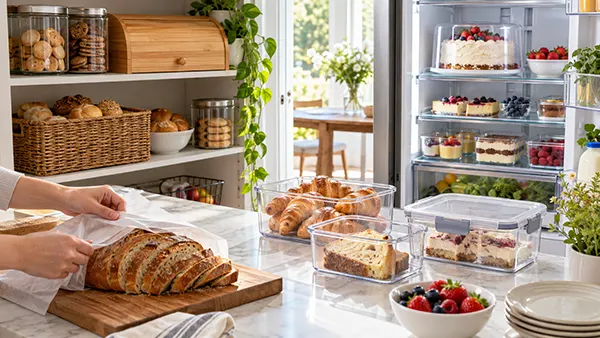
For pastries with fresh cream, cheesecake-style fillings, mascarpone, custard or other chilled components, food safety takes priority over keeping the crust perfectly crisp. The Food Standards Agency advises that cakes and desserts containing fresh cream should spend as little time as possible outside refrigeration. At home, this means keeping the main batch in the fridge and placing only the required amount on the table. A fridge should operate at 5°C or below. Store these desserts covered so that they do not dry out or absorb odours, and do not place them beneath uncovered raw meat or fish. If a chilled dessert has been made with an ingredient carrying a use-by date, that date and the ingredient’s storage instructions should also be considered when deciding how long the finished dessert can be kept.
Storing Homemade Cakes and Desserts Safely
Before deciding where a homemade cake belongs, look at its filling, topping and overall moisture rather than at the sponge alone. Plain sponge cakes, loaf cakes and other relatively dry cakes can often be kept at a cool room temperature when properly covered, particularly if they will be eaten within the next couple of days. An airtight cake box or well-fitting cover protects the surface from drying. Once the cake has been cut, the exposed edges need particular attention because they lose moisture quickly. Pressing suitable food wrap against the cut surface or arranging slices closely before covering them helps. Avoid storing an uncovered cake in the fridge simply in the hope that it will last longer; refrigeration can dry some cakes and affect their texture when chilling is not actually required for safety.
The situation changes when a cake or dessert contains fresh cream, whipped cream, cream cheese, mascarpone, custard, mousse, curd or similarly perishable ingredients. These products should be refrigerated rather than treated like an ordinary plain sponge. Cheesecakes, trifles, cream-filled cakes and many chilled puddings belong in this group. Keep them covered and place them in the fridge promptly after preparation and serving. Current UK food-safety advice recommends keeping the fridge at 5°C or below, and chilled food should spend as little time as practical at room temperature. For a homemade dessert assembled from several ingredients, use the most perishable component as the guide. A long-lasting cake layer does not extend the safe storage life of a fresh dairy filling added to it.
Homemade desserts also need sensible time management because they do not always carry the convenient dates found on packaged food. For cooked leftovers, Food Standards Agency guidance is to cool food and refrigerate it within two hours, then eat it within 48 hours or freeze it if it will not be used in that period. Specific recipes and ingredients may require a shorter period, so recipe instructions and use-by dates on perishable ingredients take precedence. Divide large quantities into smaller containers if this helps them cool more efficiently, but do not leave freshly prepared chilled desserts sitting on the worktop for several hours while waiting for the entire kitchen to be tidied. Cover them properly once cooled and write the preparation date on the container when there is any chance that you may forget when they were made.
A Simple Storage Routine That Works in an Everyday Kitchen
The easiest storage routine begins before the food reaches a cupboard, fridge or freezer. Let freshly baked bread, cakes, biscuits and pastries cool properly on a clean rack or suitable surface before wrapping them. Warm baked goods continue to release steam, and covering them too early traps that moisture. Once cool, choose a container that matches the food: a bread bin or suitable bag for everyday bread, a dry airtight tin for biscuits, close wrapping for soft cakes and buns, and a covered refrigerator container for perishable desserts. Containers should be clean and completely dry. Reusing a box that still contains crumbs, moisture or traces of an older bake can undermine the care taken with a fresh batch.
Organisation matters as much as the container. Keep the fridge at 5°C or below and avoid packing it so tightly that cold air cannot circulate properly. Ready-to-eat cakes and desserts should be protected from raw foods, with raw meat and fish kept covered and lower in the fridge so that accidental drips cannot reach foods that will be eaten without further cooking. In the freezer, label bread, cake slices and pastries with the name and freezing date, and arrange older items where they are easy to see. Small portions are generally more useful than one large frozen block because they allow you to thaw only what you intend to eat. This simple first-in, first-out habit reduces forgotten food and makes it easier to use homemade baking while it is still at its best.
Finally, treat food dates and signs of deterioration correctly. A use-by date relates to safety and should not be ignored simply because food looks or smells normal. A best-before date mainly concerns quality, so some foods may remain suitable after it if they have been stored correctly and show no signs of spoilage. Homemade baking often has no printed date at all, which makes labelling and sensible storage especially useful. Visible mould on bread or other baked goods is a reason to discard the affected food rather than cutting away the obvious patch. Dryness alone is different: stale but otherwise sound bread and cake may still be turned into useful dishes instead of being wasted. The most effective storage method is therefore not a single container or temperature, but a routine that matches each bake to its ingredients, moisture level and expected eating time.